
Mesh Bio is transforming the healthcare landscape through its proprietary digital twin technology and predictive analytics platform, built at the intersection of computational biology and artificial intelligence.
By utilizing sophisticated mathematics to model internal biological mechanisms, Mesh Bio enables physicians to visualize a patient’s unique health trajectory. This mechanistic approach provides the transparency needed to deliver personalized guidance and data-driven treatment strategies to improve patient outcomes.
The firm’s flagship product, HealthVector® Diabetes, can be used as analysis software to estimate the 3-year risk of chronic kidney disease (CKD) stage 3A or higher in adult patients aged 20-80 years.
To better understand what it does, we spoke with Dr. Andrew Wu, PhD, Co-Founder and Chief Executive Officer of Mesh Bio, and conducted a deep dive into its ecosystem of chronic disease management through predictive analytics.
What are the benefits of predictive analytics in chronic disease management?
Predictive analytics helps patients by enhancing patient care and health management. For medical professionals, it provides actionable insights that improve decision-making while reducing administrative burdens.
On a macro level, these advancements can help governments and healthcare systems improve public health strategies. Mesh Bio is leading this charge by building an innovative approach to tailoring chronic disease prevention through its DARA® Health Intelligence Platform.
According to Andrew, Mesh Bio works in a threefold process:
“(1) We structure and integrate multidimensional patient data, then (2) feed it into our analytics engine that includes our digital twin technology, and (3) we generate personalized insights about the patient and recommend care plans to the doctors.”
Eventually, all patient clinical data is translated into actionable insights. This provides tailored recommendations for doctors to review, allowing for more precise patient care steps. Ultimately, this helps patients better manage their health, lifestyle, and disease risk.
Tackling diabetes with digital twin technology
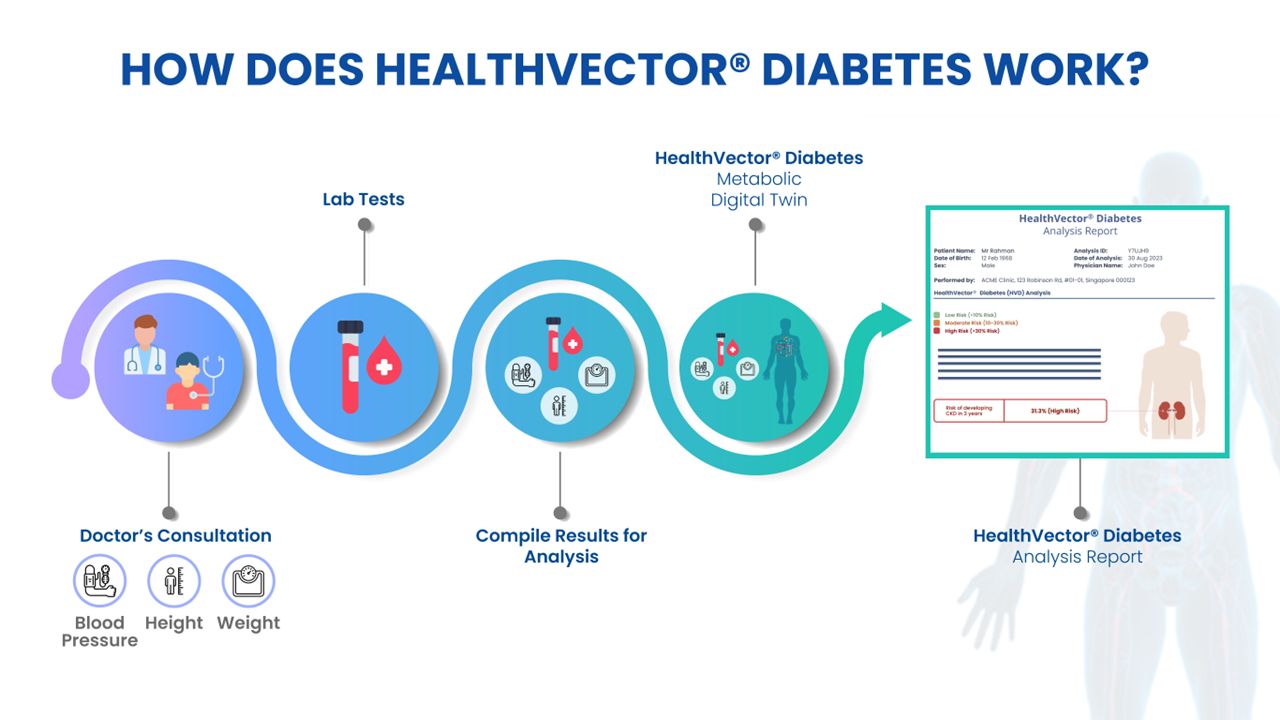
HealthVector® Diabetes, a metabolic digital twin-based Software as a Medical Device (SaMD) developed using computational systems biology and AI, is intended to predict a 3-year onset risk of chronic kidney disease (CKD) in patients with type 2 diabetes.
Its proprietary technology simulates the patient’s body’s metabolic processes, offering deeper insights into how diabetes develops and progresses in their unique physiology.
Meanwhile, its algorithm uses anonymized clinical data from hospitals’ electronic medical records to derive a risk score for predicting worsening kidney function. This has the potential to transform patient care, as clinicians can use this information to prioritize and intensify therapies to delay the progression of kidney failure.
Eventually, AI generates a tailored HealthVector® Diabetes Analysis Report that helps optimize early intervention strategies and treatment plans—turning data into clear, impactful action for patients.
Mesh Bio has made significant progress in Singapore, working with SingHealth and NHG under the I2A grant to deploy HealthVector® Diabetes in the public healthcare system.
It is also the world’s first foundational digital twin model of human biology, validated in a clinical paper published in Nature Digital Medicine—a first for the country.
Regional expansion in Southeast Asia
Mesh Bio is actively expanding its presence in Southeast Asia to improve healthcare quality across the region.
- Indonesia: Signed agreements with three new healthcare providers.
- Philippines: Launched operations in collaboration with Fullerton Health.
Since 2023, Mesh Bio has been part of the East Ventures ecosystem and is ready to build traction and repeatability in these key markets.
However, as digital transformation is relatively new to the region, the company’s biggest challenge remains educating the market on the value of these predictive analytics solutions.
How will Generative AI integrate with biotech?
The rise of Generative AI (GenAI) offers significant opportunities to improve patient care. Mesh Bio is at the forefront of this integration.
“We are really excited to incorporate trending technologies such as Generative AI into our clinical analytics engine and combine this with our foundational digital twin model, HealthVector®. It is imperative that novel analytics approaches have transparency that builds trust with healthcare providers,” Andrew stated.
These innovations are rooted in Mesh Bio’s long-term mission to be a leading global health technology company.
By leveraging digital twin technology, they aim to enable precision medicine, ensuring the right interventions reach the right patients at scale.
East Ventures’ commitment to healthcare
East Ventures has been actively investing in healthtech to tackle Indonesia’s greatest challenges—making prevention, early identification, and effective treatment more accessible.
In the coming decade, we believe that integrating technology into healthcare will present significant opportunities for Southeast Asia.
If you are a startup founder building in the healthcare, biotech, or deeptech sector, send us your pitch here.